
Spring rupture bang sound
Some owners hear it first: a loud bang from the garage, usually the spring itself separating. Look at the spring above the door, on the shaft over the header. A gap in the coil, even a small one, means it's done.
Encinitas, CA
Torsion springs on Encinitas garage doors, most built in the 1980s and 90s, wear out on a predictable schedule. Here's why they fail here and what fixing one involves.
Local causes
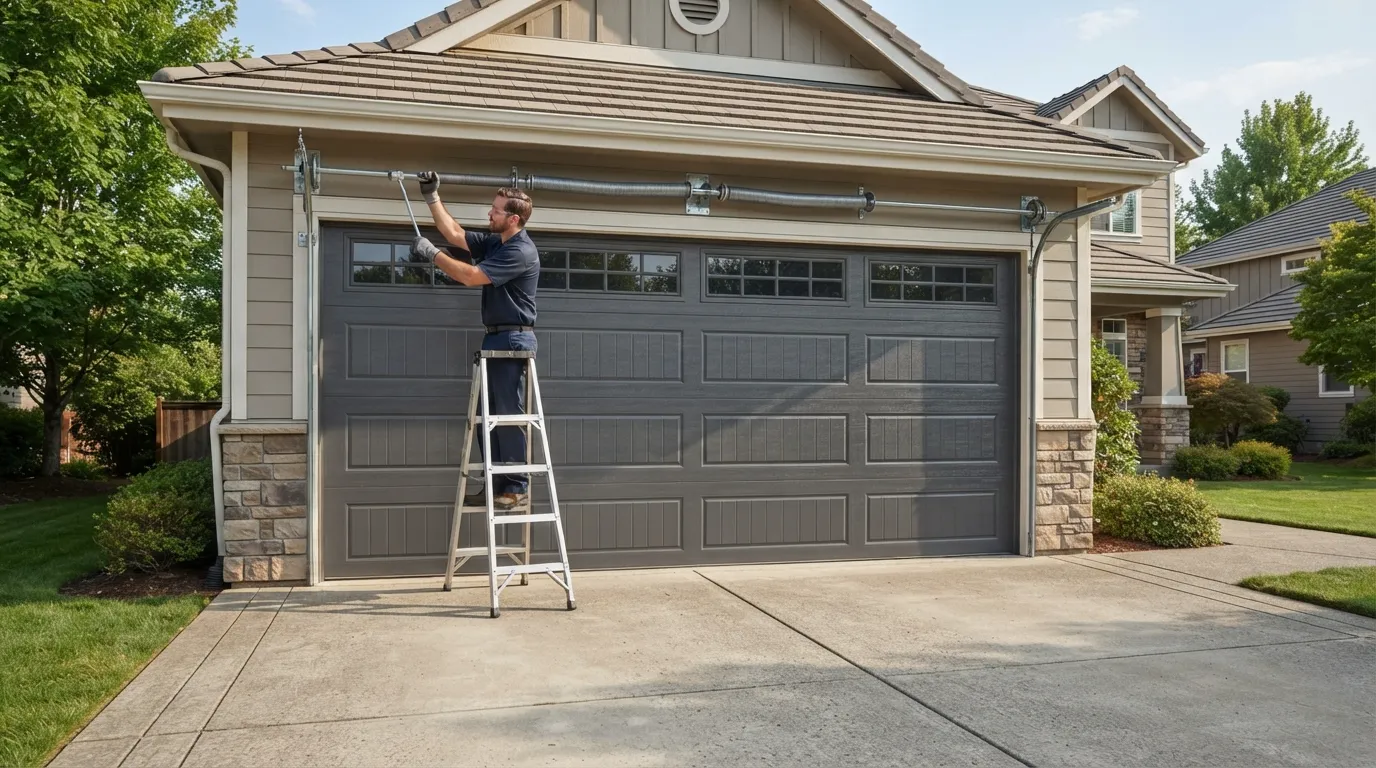
Most houses across this service area's nine named neighborhoods went up between 1970 and 2003, with a median year of 1983. That means a big share of the garages in this market still carry their original torsion springs, or a first replacement set installed decades ago. A torsion spring is rated for a set number of open-close cycles, not a set number of years, but a house built in the early 80s has had forty-plus years to rack those cycles up.
The climate here doesn't help in the way people expect. Encinitas sits in a mild temperate band, so you don't get the freeze-thaw cracking that kills springs inland or up north. What you get instead is slow. Coastal air carries steady moisture, and on a spring with worn or chipped galvanizing, that moisture works into the coil gaps a little at a time. The steel doesn't snap from cold shock - it fatigues from corrosion plus age, and it usually lets go on an ordinary Tuesday, not during a storm.
Across the roughly 22,090 households in this market, a large share of the owner-occupied houses share that same 1980s-90s build window. It's not one street or one subdivision - it's the housing stock itself.
Symptoms
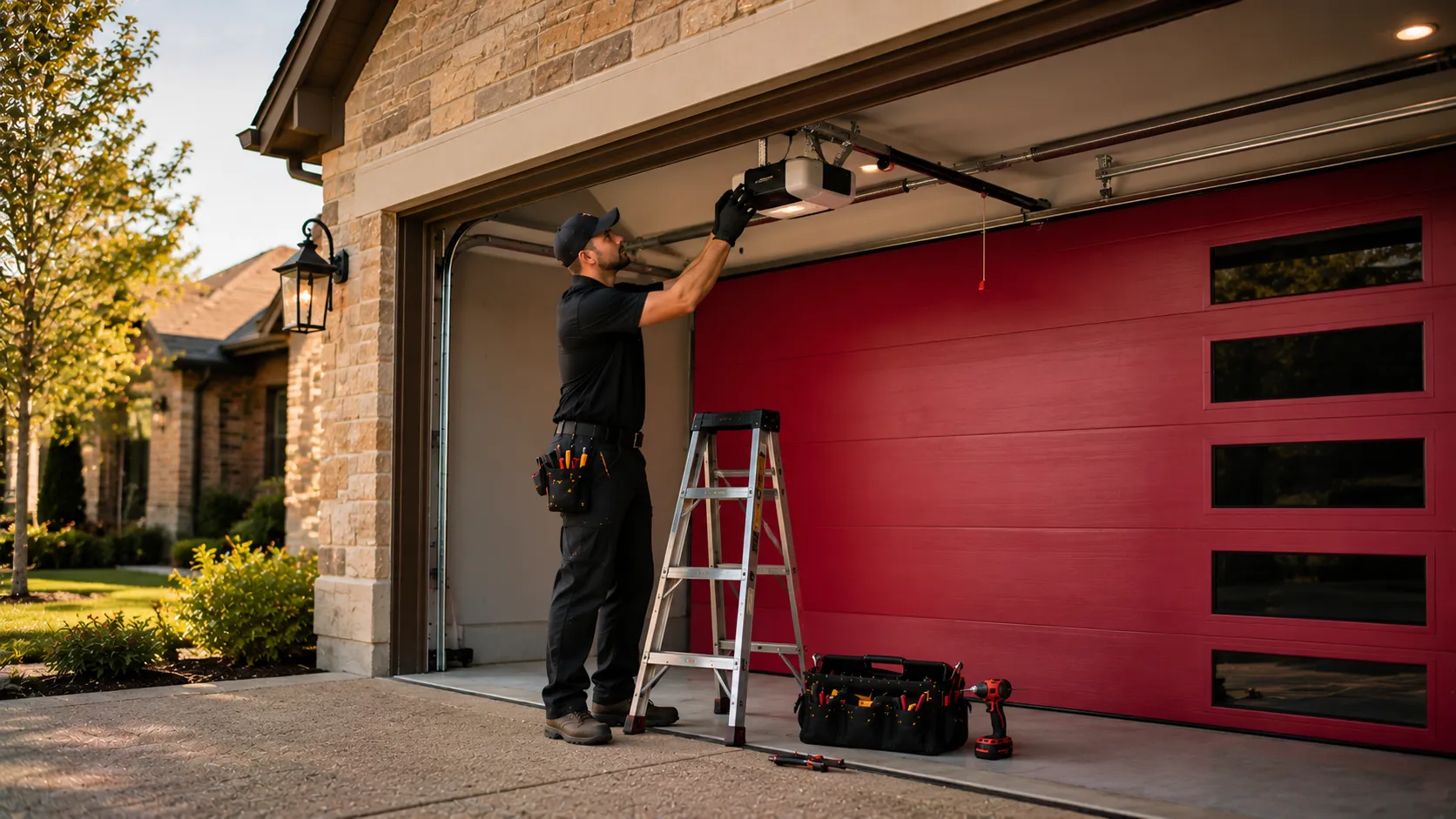
The most common call is a door that won't budge, or one where the opener strains and stalls a few inches up. If you pull the release and try the door by hand and it feels like dead weight instead of lifting with a light push, the spring has lost its tension.
Some owners hear it first: a loud bang from the garage, usually the spring itself separating. Look at the spring above the door, on the shaft over the header. A gap in the coil, even a small one, means it's done.
A cable that's gone slack on one side while the other stays taut is a second clue - that's often an unbalanced spring on a double door, where one torsion spring has failed and the other is still carrying the whole weight of the panel.
Don't confuse this with a broken cable or an off-track roller - those look similar from a distance but the fix is different. If the door lifts unevenly or drops fast the last foot, that's usually the spring, not the opener.
Timing
A straight torsion spring swap on a single door is a contained job once a tech has the right spring rated to your door's weight and drum size.
Double doors with two springs take a bit longer, and doors with extension springs on side tracks instead of torsion springs over the header are a different repair entirely - older houses in the 1970s wave sometimes still have this setup, and it changes both the parts and the time on site.
The variable that actually swings the clock is parts. If your door take a common size, the job moves fast. If it's an odd width, a heavier insulated panel from a later remodel, or a spring gauge that isn't stocked on the truck, there's a wait while the right one gets sourced.
That's the honest limitation here: nobody can quote a firm time before seeing the door, the drum size, and the wind of the spring. What's consistent is that once the correct spring is in hand, setting torsion and balancing the door is routine work, not a project.
DIY or pro
Don't. This is the one place where trade forums and a socket set aren't enough, and it's worth being blunt about why. A wound torsion spring holds enough stored force to break fingers, fracture an arm, or worse if the winding bars slip. This isn't a scare tactic - it's the actual reason every garage door manual tells owners to leave the spring alone.
With a median household income of $119,394 across this market, most owners here aren't choosing the DIY route to save money on a spring that runs a modest cost either way - they're calling because the job requires winding bars, a vise grip clamp on the track, and knowing the wind direction and wire gauge before you start. Get any of that wrong and the spring either won't hold tension or comes off the winding cone.
What an owner can safely do: watch for the symptoms above, keep the door manually released and off the opener until it's fixed, and don't force it. Everything past that belongs to someone who does this daily.
Questions
Disconnect the opener with the manual release and lift the door by hand. If it feels heavy, drops on its own, or won't stay up on its own, the spring has lost tension - the opener isn't built to lift a door with a dead spring, so it will strain or stall even if the motor itself is fine.
Torsion springs fail on cycle count and slow corrosion, not sudden events. In this area's mild coastal climate, steady moisture works into the coil over years rather than causing sudden cracking, so the spring can look fine right up until it isn't. Age plus use, not weather shock, is almost always the real cause.
Single doors typically run one torsion spring; double (two-car) doors usually run two, one on each side of the center bracket. If your double door has two springs and only one fails, the door will lift unevenly or lean to one side - that's a sign to check both, since the surviving spring is now carrying extra load.
Explore more
Ready when you are
Encinitas Garage Door Pros repairs and installs garage doors, springs and openers in Encinitas, CA and the surrounding area.